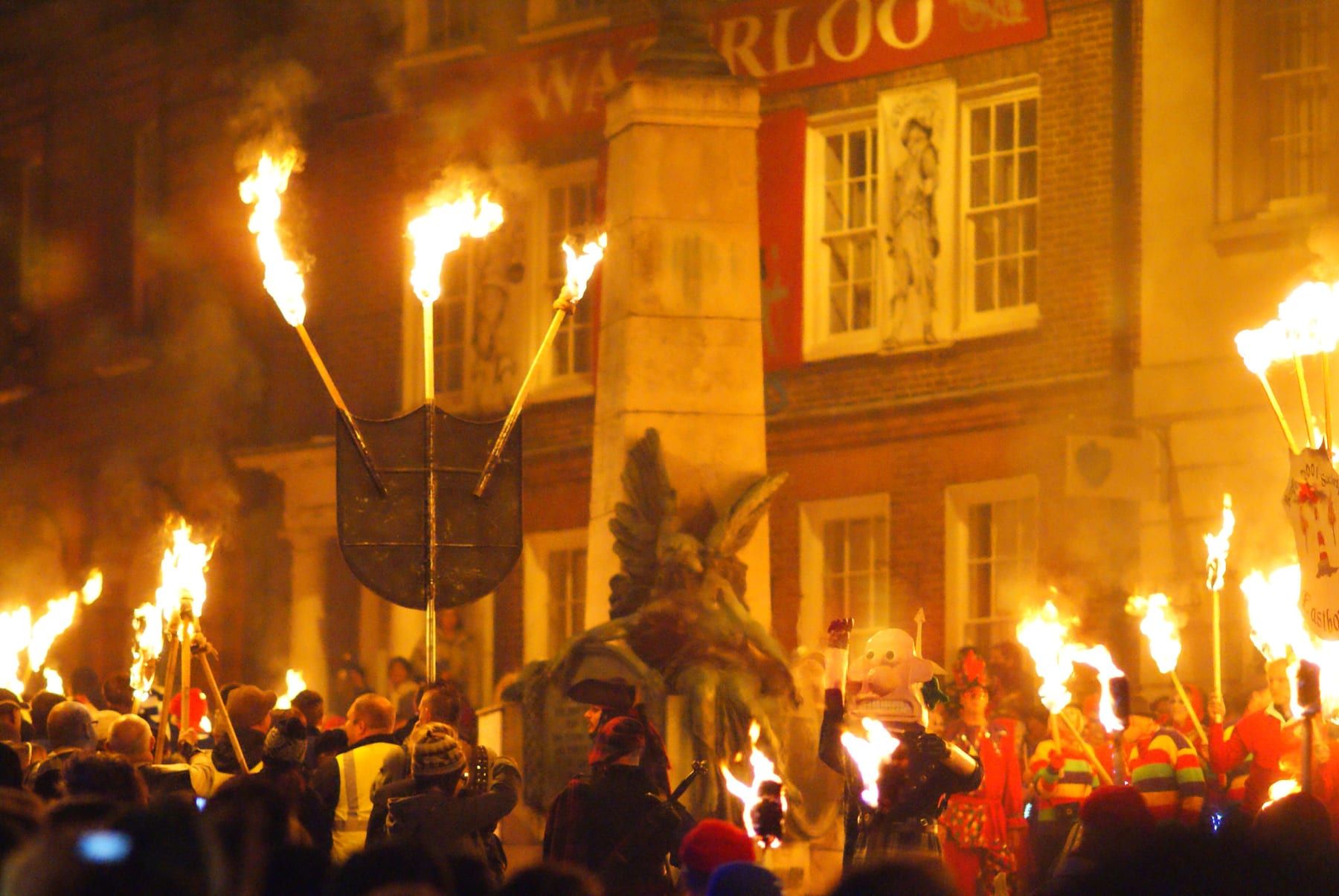
Every 5 November, unless it falls on a Sunday, Lewes shuts its roads, stops its trains and hands the town to its six bonfire societies. Tens of thousands of people pack a town of seventeen thousand to watch processions of flaming torches, hear bangers go off under their feet for six hours, and see effigies of the year’s villains blown to pieces at five separate fire sites. Calling it a fireworks display undersells it badly. It is the last big folk festival left in southern England, and the processions come along the High Street directly beneath the apartment’s windows.
2026 and 2027
At the time of writing, Thursday 5 November 2026 is already booked. Friday 5 November 2027 is the next one, and if you want it, ask now: Bonfire Night in Lewes is booked a year ahead and carries a longer minimum stay. Check dates or send us a message.
What actually happens
Lewes has six societies, each with its own colours, costumes, procession route and fire site: Cliffe, Lewes Borough, Commercial Square, Southover, South Street and Waterloo. From about five o’clock they march separately through their own parts of town. Around seven they combine for the Grand United Procession along the High Street, thousands of people in smugglers’ stripes and Tudor, Viking and every other kind of costume, carrying torches, dragging burning tar barrels, and rolling their tableaux, the huge effigies packed with fireworks. Seventeen burning crosses commemorate the seventeen Protestant martyrs burned in Lewes in the 1550s; a wreath is laid at the war memorial; and the whole thing is louder, closer and more anarchic than anything a council would license today. Later each society goes to its own fire site outside the centre for the bonfire, the effigies and a fireworks display, running until eleven or so.
Why the town says “don’t come”
Every year the councils, police and the societies themselves ask outsiders not to travel. They mean it. The roads into Lewes start closing during the afternoon. Trains don’t stop at Lewes, Falmer, Cooksbridge, Glynde or Southease from 5pm until the next morning. There is nowhere to park for miles. Pubs are ticket-only or shut. The crowds in the narrow streets are dense enough that pushchairs are impossible and small children are a worry. If you are going to be in Lewes on the night, the only sensible way is to be staying in Lewes, on foot, with somewhere warm to retreat to. Which is the apartment.
How the evening works from the apartment
Arrive on the 4th, or on the 5th before lunch, and leave the car in your parking space: it is not moving again until the morning. Eat properly in the afternoon; the food on the street is hot dogs and queues. Watch the early processions from the window, then go down to the High Street for the Grand United, which passes the front door. Come back up when the cold or the bangers get too much, make tea, and go out again for a fire site if you have tickets (they sell out weeks ahead; Waterloo’s site has traditionally been free). Be back for the fireworks, some of which you can see from the windows. Bed at midnight, and the town is quiet by one.
What to bring
Warm layers, boots you don’t mind about, ear defenders for anyone under twelve or over-sensitive, a small bag rather than a big one, cash for the fire sites, and no expectations of getting anywhere fast. Leave the car, the pushchair and any timetable at home.
Rules for the night
Once you are back inside, remember the walls are old and sound carries, and eight is still the maximum number of guests. The neighbours have lived through a great many Fifths and are very tolerant, up to a point.
The rest of the weekend
The town is itself again by mid-morning on the 6th, and a good deal of the fun of a bonfire weekend is Lewes when it’s quiet: the castle, the priory ruins, the bookshops, a walk up Mount Caburn, and a slow lunch. Two or three nights is the way to do it.
Last checked September 2026. Opening times and prices change; the links go to the official sources.
Header photo: Peter Trimming, CC BY-SA 2.0, via Wikimedia Commons.